
Water damage is one of the most stressful things a homeowner can face. Whether it’s a burst pipe, a flooded basement, or a leaking roof, the aftermath demands fast decisions. One of the first questions most people ask is: Can I handle this myself, or do I need to call the professionals?
The answer isn’t always straightforward. It depends on the severity of the damage, your skill level, the materials involved, and the hidden risks you might not see coming. This guide breaks down everything you need to know before you pick up a mop or pick up the phone.
Understanding the Types of Water Damage
Before deciding on DIY or professional restoration, you need to understand what category of water damage you’re dealing with. Restoration professionals classify water damage into three categories, and these categories should heavily influence your approach.
Category 1 – Clean Water originates from a sanitary source like a broken supply line, overflowing sink, or rain. This is the least hazardous type and is generally the most DIY-friendly.
Category 2 – Grey Water contains significant contamination and can cause illness if ingested. This includes water from dishwashers, washing machines, and toilet overflows with urine. DIY is risky here unless you have proper protective equipment and a thorough understanding of sanitation protocols.
Category 3 – Black Water is highly unsanitary and contains pathogens, sewage, or chemical contamination. Floodwater from rivers and streams, toilet backflows, and standing water that has been stagnant for more than 24–48 hours all fall into this category. This type should almost always be handled by professionals.
When DIY Water Damage Restoration Makes Sense
There are genuine scenarios where rolling up your sleeves is the right call — both practically and financially.
Small-Scale, Category 1 Damage
If a supply line under your sink bursts and you catch it quickly, you may be looking at a wet cabinet floor and a soggy rug. In cases like this, a shop vac, fans, a dehumidifier, and a few days of patience may be all you need. The key word here is quickly. Water damage that’s addressed within the first hour or two has a far better prognosis than damage that sits overnight.
Surface-Level Damage on Non-Porous Materials
Tile, sealed hardwood, and concrete are more forgiving than drywall or carpet. If the affected materials are non-porous and you can confirm the water didn’t seep under or behind them, a thorough dry-out may be achievable on your own.
You Have the Right Equipment
DIY restoration isn’t just about effort — it’s about equipment. A household fan is not a substitute for an industrial air mover. A regular dehumidifier pulls significantly less moisture per day than a commercial-grade unit. If you have access to proper equipment, either through rental or ownership, your DIY outcome improves dramatically.
Cost Consciousness Is a Real Factor
Professional water damage restoration can range from a few hundred dollars for minor work to tens of thousands for major structural damage. If you’re dealing with a small, contained incident and your budget is tight, DIY can be a responsible choice — provided you do it correctly.
The Risks of Going DIY
This is where many homeowners underestimate the situation. Water damage looks simpler than it is on the surface.
Hidden Moisture Is the Enemy
Water travels. It wicks into drywall, runs under flooring, seeps behind baseboards, and pools inside wall cavities where you can’t see it. Even if the surface appears dry, moisture can remain trapped for weeks, creating the perfect environment for mold growth. Mold can begin colonizing within 24 to 48 hours in the right conditions. Without moisture meters and thermal imaging, you may be declaring victory while the real problem festers inside your walls.
Mold Risk
Mold is not just a cosmetic problem. Certain mold species produce mycotoxins that can trigger respiratory problems, allergic reactions, and long-term health issues. If your DIY dry-out doesn’t reach 100% of the affected area, you may be trading a manageable water damage claim for a serious mold remediation project down the road.
Structural Damage You Might Miss
Prolonged moisture exposure weakens structural elements like subfloors, joists, and load-bearing framing. A professional can assess structural integrity in ways the average homeowner simply isn’t equipped to do. Missing this can turn a straightforward restoration job into a major renovation.
Insurance Complications
If you plan to file a homeowner’s insurance claim, documentation matters. A professional restoration company creates a paper trail — moisture readings, photos, equipment logs, and scope of work reports — that supports your claim. DIY restorations can complicate claims by leaving gaps in documentation or by inadvertently voiding coverage if the damage spreads due to improper remediation.
Electrical and Safety Hazards
Water and electricity are a deadly combination. A flooded basement may have submerged outlets, appliances, or electrical panels. Entering a water-damaged space without first confirming the power is off can be fatal. Professionals are trained to assess and navigate these hazards. If there’s any uncertainty about electrical exposure, stop and call a professional.
Side-by-Side Comparison
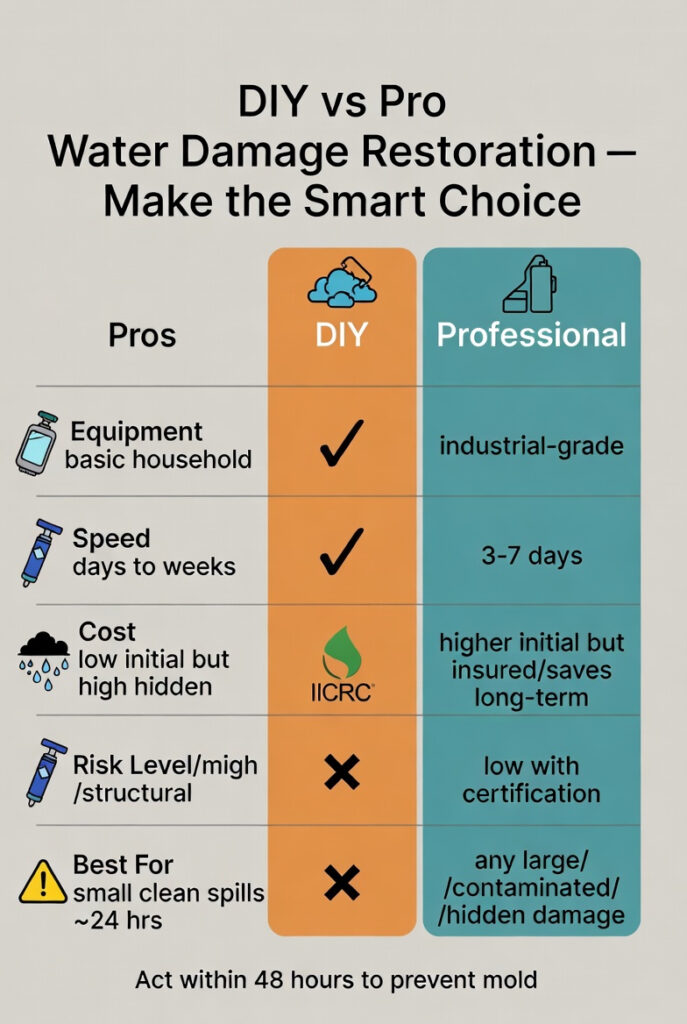
| Aspect | DIY | Professional |
| Best for | Small Cat 1 spills <24 hrs | Any larger, contaminated, or hidden damage |
| Cost (initial) | $100–$800 (tools/materials) | $2,000–$6,000 (often insured) |
| Long-term risk | High (mold, structural issues) | Very low |
| Time | Days to weeks | 3–7 days typical |
| Equipment | Basic household | Commercial-grade + monitoring |
| Insurance help | None | Full documentation & coordination |
| Health/Safety | You handle it | Certified technicians + proper disposal |
The Restoration Process: DIY vs. Professional
Both follow similar steps, but execution differs dramatically.
Professional Process (IICRC Standard):
- Emergency response & detailed inspection (moisture mapping).
- Water extraction (removes 90%+ of water quickly).
- Structural drying with psychrometrics (science of drying).
- Cleaning, sanitizing, deodorizing.
- Repairs/reconstruction.
- Final testing & clearance.
When to Call the Professionals — No Exceptions
Some situations remove the DIY question from the table entirely.
Sewage involvement means Category 3 water is present. This is a biohazard situation requiring professional-grade protective equipment, specialized cleaning agents, and proper disposal protocols.
Flooding from external sources — rivers, stormwater, or groundwater — brings contamination you cannot safely identify without testing. Never treat exterior flood damage as a DIY project.
Damage affecting more than one room or multiple levels almost certainly means water has traveled beyond what’s visible. The scope and hidden nature of multi-room damage makes professional moisture mapping essential.
Any involvement of structural elements — sagging ceilings, buckled floors, cracks in walls — signals that the damage may have compromised the integrity of your home. This requires professional assessment before any restoration work begins.
Suspected mold after 48 hours requires not just drying, but professional mold remediation with proper containment and air filtration.
What Professional Restoration Actually Involves
Understanding what professionals do helps justify the cost — and helps you evaluate quotes.
A certified restoration company following IICRC (Institute of Inspection, Cleaning and Restoration Certification) standards will begin with a thorough assessment using moisture meters and thermal imaging cameras to map all affected areas, including those behind walls and under floors. They establish a drying plan based on the psychrometrics of the space — temperature, humidity, and airflow — and deploy industrial air movers and dehumidifiers in calculated configurations to achieve the fastest, most complete dry-out.
Throughout the process, they monitor moisture levels daily and adjust equipment placement accordingly. Documentation is recorded at every step. If mold is discovered, they implement containment protocols to prevent spore spread to unaffected areas. Once the structure reaches target moisture levels, they can assist with or coordinate repairs to damaged materials.
This is not something that can be replicated with a box fan and a rented dehumidifier.
The Hidden Cost of Doing It Wrong
The financial argument for DIY can feel compelling at the moment. But the cost of doing it wrong often far exceeds what professional restoration would have cost upfront. Mold remediation, structural repairs, and replacement of materials that could have been saved with proper initial drying can add up to many times the cost of a professional restoration job.
Insurance is another factor. Many policies will cover professional restoration work. They may not cover damage that resulted from delayed or improper remediation.
Final Thoughts
DIY water damage restoration is not a myth — for the right type of damage, caught quickly, with the right tools, it is a legitimate option. But it demands honesty about the scope of the situation, the resources available, and the risks of getting it wrong.
When in doubt, err on the side of calling a professional. Most reputable restoration companies offer free assessments, and even if you ultimately handle the work yourself, a professional inspection can give you the information you need to proceed safely and effectively.
Water damage doesn’t wait, and neither should you. The faster you act — and the more honestly you assess the situation — the better your outcome will be.
Always consult a certified restoration professional (look for IICRC certification) for any water damage situation involving contaminated water, structural concerns, or damage that has been present for more than 24 hours.
FAQs
Ask yourself these questions before deciding how to proceed:
How long has the water been present?
Less than an hour and confined to a small area: DIY may be viable. More than 24 hours: call a professional.
What is the water source?
Clean water from a known supply line: DIY is reasonable with proper equipment. Anything involving sewage, flooding, or unknown sources: call a professional.
How large is the affected area?
Less than 10 square feet on non-porous surfaces: DIY is reasonable. Anything larger, or any penetration into walls or flooring: call a professional.
Do you have the right equipment?
If you cannot access at minimum an industrial dehumidifier and air movers, your DIY results will be limited.
Are there any safety concerns?
If there’s any possibility of electrical exposure, structural compromise, or biohazard contamination: stop and call a professional immediately.